
Most flight school software answers one question. Who flew what, when, and what it cost. That's the scheduling and billing question and it matters.
It is not the question an FAA inspector opens with. What they want to know is whether the student actually met the standard, whether the instructor who signed them off was legal to do it, and whether you can prove either one while they're sitting at your table.
Earlier this year I watched that happen. AeroDynamic Aviation, one of our schools, was going through Part 141 certification, and I sat in on the final inspection. That is the phase the FAA calls Demonstration and Inspection, where they verify that a school's procedures, programs, facilities, equipment and personnel actually meet the requirements. It is the closest thing an owner gets to a checkride. Jen Watson, AeroDynamic's co-owner, took it. I was there to answer for the recordkeeping, and we walked the inspector through a full student record end to end. The school passed, and their principal inspector accepted FlightSense as AeroDynamic's recordkeeping system under a Letter of Authorization.
One thing I didn't know when we started working with them. AeroDynamic opened in 1960 as Amelia Reid Aviation, named for the instructor who founded it and taught more than 4,000 students at Reid-Hillview before she died in 2001. Her father-in-law and four other pilots had opened the field itself in 1939. The school took its current name in 2014.
We named our assistant Amelia, after Earhart. Different Amelia, same idea. I didn't put it together until I was standing in the school Amelia Reid started, sixty-six years after she opened it, watching an FAA inspector work through a system named Amelia.
AeroDynamic Aviation at a glance
- Jen Watson, co-owner and chief instructor, also an FAA-designated pilot examiner
- Two training locations, San Jose and Monterey, California
- Around 45 flight instructors
- Mid-transition from Part 61 to Part 141 certification at the time of the inspection
"Over the past 14 years of running a flight school, I've searched for and tried many different programs. Until FlightSense, none of them covered everything I needed from flight school management software."
—Jen Watson, Owner, AeroDynamic Aviation
What the inspector wanted to see
Her core concern was instructor compliance, not the calendar or the invoices. The question, close to word for word, was how do I make sure I'm not sending an unqualified instructor out to fly. She meant a current medical, TSA training every twelve months, CFI renewal every twenty-four, a current flight review. Could the school show, on demand, that every instructor teaching that day was qualified? That's the gap. Most of these tools were built to book airplanes, not to track qualifications against AC 141-1B.
Proving the student met the standard
The second thing she pressed on was proof of the training itself. Not that a flight happened, but that the student met the standard. Her example was specific. Instructors endorse students for a commercial checkride without the ten hours of attitude instrument instruction FAR 61.129 requires. A schedule can't catch that, and a logbook barely can. It takes a record built around the standard itself to do that job.
FlightSense records every hour of time and activity against a course, so a school can hold a student's record up against the Part 61 minimums and see where they stand. The clearest ask out of that room was to go further and put those requirements next to course progress, derived from the record instead of tracked alongside it. It came from the inspector, and it came from Jen, who's an examiner herself and knows exactly what has to hold up.
Why we built it backwards
That's why we built FlightSense in an unusual order. Everyone else starts with the schedule and bolts training on as a logbook. We started with the record the FAA audits (the debrief, captured as a structured, ACS-tagged training entry) and built the operation around it. An instructor talks through the flight on the walk back to the FBO, and by the time they sit down it's a scored record mapped to the standard, rolling up into the student's progress on its own. The training documentation is a byproduct of the workflow, not a second job at the end of the day.
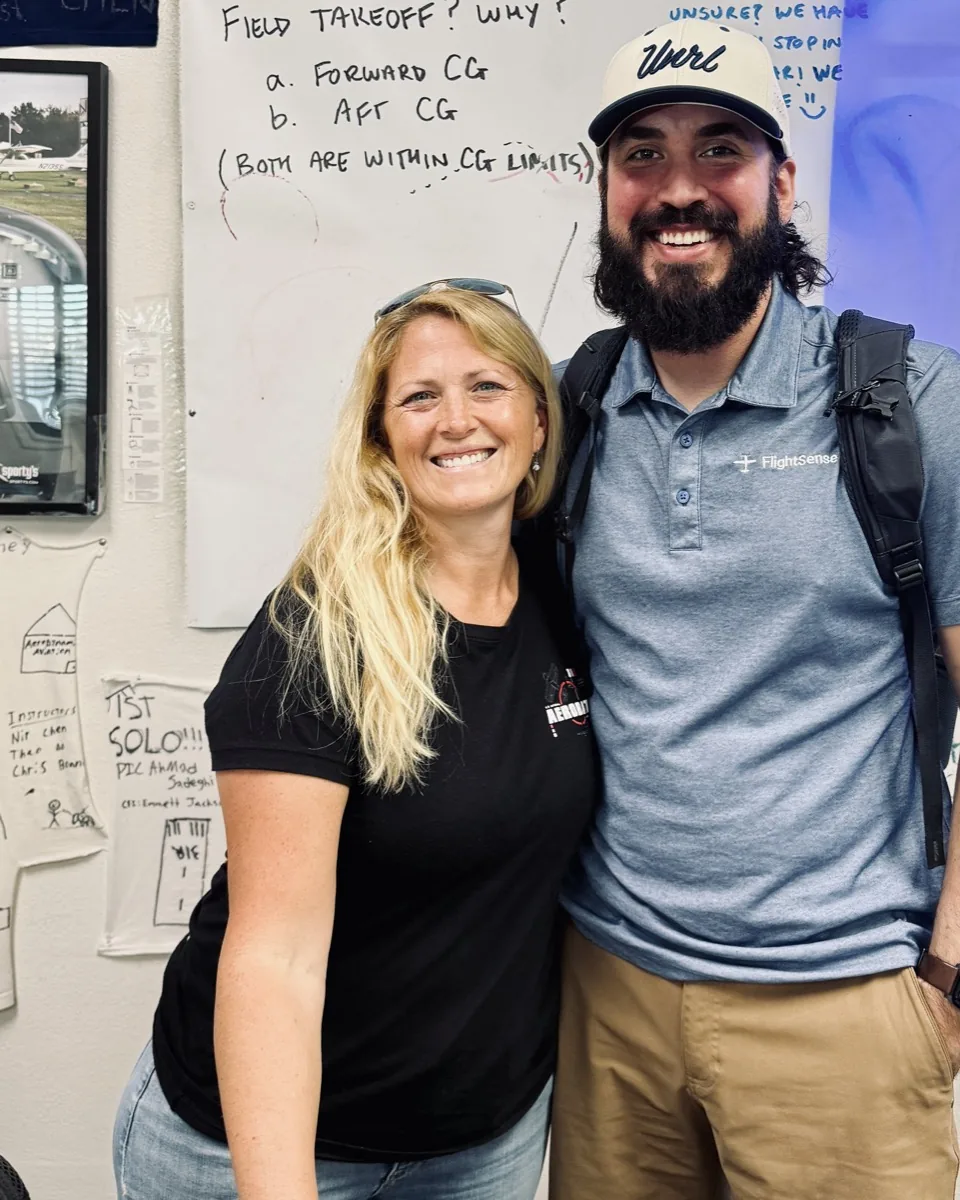
In Jen's words
"Over the past 14 years of running a flight school, I've searched for and tried many different programs. Until FlightSense, none of them covered everything I needed from flight school management software.
Taylor and his team worked with me constantly through the setup process and FAA inspections for Part 141 to make sure everything went smoothly during implementation. When the FAA sat down with our records, everything they needed for electronic record keeping was there.
As a pilot examiner also, I know exactly what needs to be demonstrated for a practical test: that every requirement has been properly logged and every completion standard was met satisfactorily. FlightSense just shows you that, clearly. The feedback I get from my instructors is that they can walk in, use it, and know it meets the requirements.
I couldn't be more impressed by this simple-to-use, but extremely capable program."
—Jen Watson, Owner, AeroDynamic Aviation
If you run a Part 141 program, you already know which question keeps you up before an audit. It isn't scheduling. It's whether the records will hold up. That's the part we build for, and the person whose whole job is asking the hardest version of that question accepted it as a school's system of record.
If you want to see how the debrief becomes the record, request a demo.